Friday, October 26, 2007
Roman Entertainment
For over two hundred years, Rome was a kingdom, then for about five hundred years, a Republic, and finally for about another five hundred years, an empire. Through all those centuaries, entertainment was a huge part of the Roman culture; it distracted people from having time and excuses to plot against the current emperor, but also gave the citizens a relaxing life.


Wednesday, October 24, 2007
~Chariot Racing~
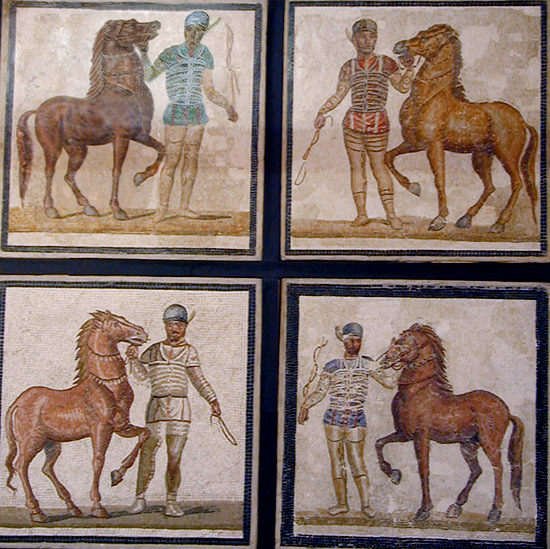
Around 6 BC, Circus Maximus was built of wood, which burned down so that the Romans could learn from their mistakes and build another one, this time of marble and concrete. Romans enjoyed circuses, but favoured chariot- racing over Roman athletics, even though the circuses included both. The admission was free for poor citizens, but the richer could pay to get better seats.
Charioteers were dressed in red, blue, green, and white. They raced standing up in their chariots with the reins tied around their waist, which meant that the charioteer carried a knife with him at all times in case he were trapped under the chariot. A two- horsed chariot was called a biga, a three- horsed chario; triga, and a quadriga was a four- horse chariot. Some charioteers used up to ten horses to show off, but dogs, tigers and even ostriches were allowed to pull a chariot.
The chariots and their drivers were loaded into a small stall with spring- loaded gates which would pop open once the mappa (cloth) was dropped. Competitors raced seven laps around a tight- cornered track in the circus arena. A spina was placed in the middle of the track, and the charioteers drove around it.
The winner of the race would become extremely famous around Rome, especially if they kept on winning. Gaius Appuleius Diocles was perhaps the most famous charioteer in all of Rome; it is said that he raced in 4257 races, winning 1462 times and coming in second 1437 times.
~Gladiators~

Romans also liked gladiator fights. Gladiators were usually slaves and social outcasts who were bought and trained to be a gladiator, or were trying to win their freedom. Sometimes free Romans, even some women fought with each other as well. Romans came to hate the Christian religion and threw believers into the arena with hungry lions. Elephants, zebras, or giraffes could be trained to fight with each other to their death, or to kill humans.
The gladiators fought in an ampitheater- a huge arena that could seat thousands of people and the floor of the fighting area was covered with sand to soak up any blood. The Colosseum was one of the biggest theaters in Rome, seating up to 50,000 people. The arena could also be flooded with water to hold boats- which meant that navel battles were hosted.
There were ten main types of gladiators:
~ Myrmillo gladiators: carried dagger and shield and wears a wide leather belt and leg bands
~ Thracian gladiators: uses small shield and curved dagger, and has greaves on both legs
~ Andabatus gladiator: wears a helmet that covers whole face while riding horseback and charging at opponent
~ Essedarius gladiator: drives a horse- drawn chariot
~ Retarius gladiator: tries to capture opponent with net, and the left arm and shoulder are protected with armour
~ Samnite gladiator: wears a helmet with a visor, a crest, carries a sword and a large shield
~ Dimarchaerius gladiator: fights with two swords and wears very little armour
~ Laquerius gladiator: Something like a Retarius gladiator, but with a lasso instead of a net
~ Secutor gladiator: chases the opponent with little armour
~ Velitus gladiator: only has a spear
 Before the fight began, there was a warm- up match with wooden swords while the audience bet on the competitors. Then musicians would perform as the real fight began. Before a competitor was killed, they could appeal to the emperor to see if they would be shown mercy. The emperor would then ask the crowd, and if the spectators raised their thumbs, then he/she would be allowed to live. However, thumbs down meant good-bye to you!
~Drama~

During the time that Rome was a republic, there were sixty-six holidays in a year, but by the time Marcus Aurelius ruled as Emperor, there was one hundred thirty-five holidays a year. The Romans favoured watching gladiator fights over watching plays, but most people went to see plays on holidays. Most plays were held in the morning so that there would enough light, and also in the afternoon. Plays consisted of tragedies, comedies, farces, and pantomines. Comedies usually lasted about two hours. However, Romans prefered to watch farces and pantomines in theaters that were built at the bottom of a hill.
Slaves were the actors on stage, and worked for another man, the manager, who liked to have as little actors as he possibly could. One person ended up playing more than one part, so they used props to show the characters apart. A black wig meant a young man, a grey wig meant an old man, and red wigs symbolized slaves. A brown mask indicated a rich man and white, a woman. Smiles or frowns were painted on the masks to show different feelings. A purple gown represented a rich man; striped toga, boy; short cloak, soldier; red toga, poor man and short tunic, slave. Managers treated their slaves to dinner if the show had done very well.

Women were not allowed to act, so the masks came especially useful in that matter. The Roman way of acting was to have one actor talk, while another one mimed the action, music playing all the while. The audience loved gore and blood, so one showing of Daedaus and Icarus was the all-time favourite. The actor had tried to fly, and of course he fell, and ended up dying.
~Public Baths~
For the Romans, public baths were for leisure, but also was for socializing. Public baths, called Thermae, included shops that sold food, ointment, clothing, allowed people to visit gardens, gyms, libraries, museums, promenades, and relax in massage rooms.
 Emperor Diocletian built a pool area that covered 32 acres, and Emperor Caracella's pool covered 27 acres.
In the center of the public baths was a tepidarium, which was a heated hall that included the dressing room. On one side of it was the frigidarium, a cold water pool that was around 200 feet by 100 feet. The other side was a calidarium, which was a hot water pool with lots of steam. The poolsides were decorated with statues and other works of art.
Emperor Diocletian built a pool area that covered 32 acres, and Emperor Caracella's pool covered 27 acres.In the center of the public baths was a tepidarium, which was a heated hall that included the dressing room. On one side of it was the frigidarium, a cold water pool that was around 200 feet by 100 feet. The other side was a calidarium, which was a hot water pool with lots of steam. The poolsides were decorated with statues and other works of art.
~Banquets and Parties~
The Romans loved to chat, enjoy themselves, and eat. The solution? A party or a banquet, where they could do all three at the same time. The meals could be as little as 3 courses, or as many as 10 courses. The first course was like an appetizer- guests munched on mice, olives, salad, snails, oysters, and peahens' eggs. The second course of more solid food- people chomped down meat, fish, and stuffed doormice. The third course was the main course- party-ers chewed up ostrich, flamingo, peacock, and wild boar. The fourth and (perhaps) last meal worked as desert- everyone delicately ate nuts, fruits, stuffed dates and honey cakes.
While the guests dined, acrobats, dancers, and jugglers entertained them. Some very rich Romans had so much fun that they didn't want to leave, and wanted to eat more but they were full, so they vomited everything they had just swallowed into their stomach out again.
While the guests dined, acrobats, dancers, and jugglers entertained them. Some very rich Romans had so much fun that they didn't want to leave, and wanted to eat more but they were full, so they vomited everything they had just swallowed into their stomach out again.
Subscribe to:
Posts (Atom)