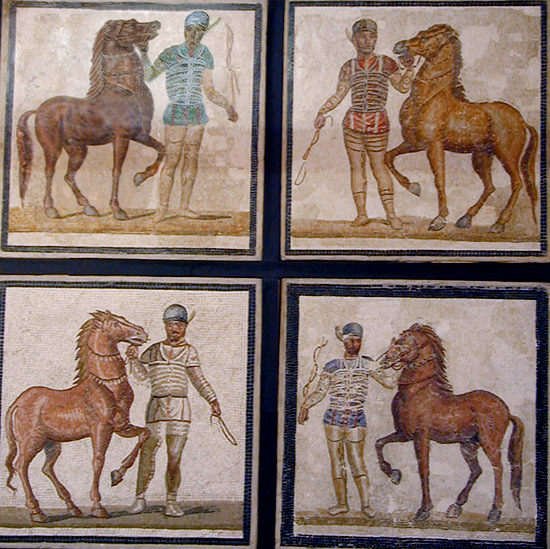
Around 6 BC, Circus Maximus was built of wood, which burned down so that the Romans could learn from their mistakes and build another one, this time of marble and concrete. Romans enjoyed circuses, but favoured chariot- racing over Roman athletics, even though the circuses included both. The admission was free for poor citizens, but the richer could pay to get better seats.
Charioteers were dressed in red, blue, green, and white. They raced standing up in their chariots with the reins tied around their waist, which meant that the charioteer carried a knife with him at all times in case he were trapped under the chariot. A two- horsed chariot was called a biga, a three- horsed chario; triga, and a quadriga was a four- horse chariot. Some charioteers used up to ten horses to show off, but dogs, tigers and even ostriches were allowed to pull a chariot.
The chariots and their drivers were loaded into a small stall with spring- loaded gates which would pop open once the mappa (cloth) was dropped. Competitors raced seven laps around a tight- cornered track in the circus arena. A spina was placed in the middle of the track, and the charioteers drove around it.
The winner of the race would become extremely famous around Rome, especially if they kept on winning. Gaius Appuleius Diocles was perhaps the most famous charioteer in all of Rome; it is said that he raced in 4257 races, winning 1462 times and coming in second 1437 times.


No comments:
Post a Comment